The Second World War has no shortage of famous names. Pilots, commanders, scientists and political leaders dominate its history. But as I researched photographic interpretation, I kept coming across another group whose contribution is much less visible: the women of the Women's Auxiliary Air Force.
I knew that women had worked as photographic interpreters during the war. What I had not appreciated was how central their work could be.
One story in particular changed that perception.
In 1943, reconnaissance photographs of Peenemünde, on the Baltic coast, were being examined for evidence of German weapons development. Among the interpreters studying them was Constance Babington-Smith. Her work helped identify the significance of what appeared in those photographs, contributing to the growing intelligence picture of Germany's V-weapons programme.
What strikes me about the story is the distance between the action and its consequences.
No dogfight. No raid. Just photographs on a table, a stereoscope and someone who knew what to look for.
Yet what was found at Peenemünde helped lead to Operation Hydra, the RAF attack on the research centre in August 1943.
For me, Peenemünde became the clearest expression of what a photographic interpreter could contribute to the war. It also helped define what Chinagraph should be about.
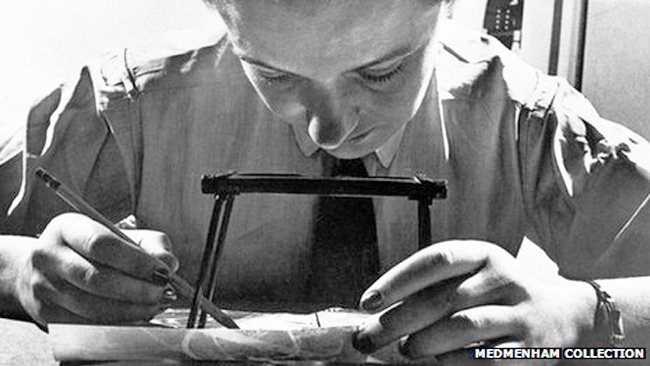
Finding a character
As the research continued through books, documentaries and museum visits, Babington-Smith became an obvious inspiration for the person behind the player's desk.
For a while, I considered using her directly. I eventually decided against it.
Chinagraph is not intended to be a biography, and making its protagonist a real historical figure would mean either restricting the game to her actual experiences or attributing fictional events to a real person.
Instead, I wanted a fictional WAAF interpreter who could embody what I saw in Babington-Smith and in the photographic interpreters, men and women alike, doing this work, while allowing the game to explore different missions and situations.
That decision also helped clarify the game's core loop. The jigsaw sequences and bombing missions have their place, but they are satellite modes.
The centre of Chinagraph is interpretation: examining a photograph, identifying what matters and understanding its tactical or strategic importance.
Peenemünde represents the climax of that idea.
The player may never leave the interpretation room. But what they discover there can determine what happens hundreds of miles away.